
Brief history
The capital of Andalusia aka if not Hercules then the Moors
L
egend has it that Seville was founded by Hercules himself, who then bequeathed it to his son Hispalis, which gave rise to the ancient name of the city: Hispalis.
On the photo – columns of Hercules with the hero, standing next to the Parliament (close to the Basilica de Macarena).
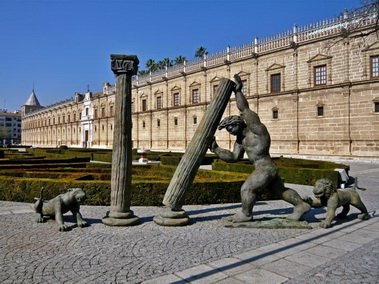
According to historians, the more likely genesis is the settlement of the people of Tartessos, who in the 8th century BC subjugated the island on the river Quadalquivir (Guadalquivir)- the modern center of Seville.
In 206 B.C.E. the Romans, belligerent with the Carthaginians, conquered Hispalis and rebuilt it as a Roman town. Wide streets, aqueducts, and classical temples were created. Julius Caesar elevated the settlement to the rank of a colony and, a bit narcissistically, renamed it Julia Romula. During six hundred years of Roman rule, the city flourished as a commercial port and the cradle of early Christianity after the martyrdom of two sisters, Rufina and Justa, who are patron saints of Seville to this day.
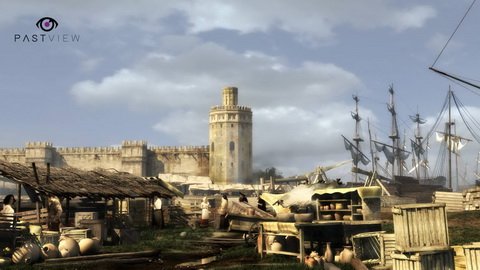
However, the 5th century brought enormous changes – the city fell victim to the Vandals first, and then the Visigoths, who gave it a shorter name of Spali. During this period, Catholic influence significantly strengthened, and the local Archbishop Izydor, later elevated to the rank of a saint, made exceptional contributions to the development of science.
However, it was not Christianity that elevated Seville to the heights of cultural and intellectual development. In 712, nine thousand Moors invaded Andalusia, successfully cracked down on the Visigoths, and took over their cities – Spali became the Arabic Išbīliya (which gave rise to the present name of Sevilla). Christians who adopted the Muslim religion received special privileges, and the city was subordinated to the Caliphate of Cordoba.
The Arab domination of Seville lasted five hundred years, which turned out to be a period of exceptional splendor. After a brutal, though successfully repulsed, attack by the Vikings in the 9th century, the city expanded its defensive walls – Torre del Oro, a 12-sided watchtower, was constructed. An impressive mosque was also built with the Giralda minaret accompanying it, though it wasn’t called that then. Today you can find the memories of it in the Seville Cathedral and its bell tower, the fourth largest temple in the world. The crowning achievement of Muslim architectural virtuosity was the Alcázar Royal Palace, a UNESCO World Heritage Site (have a look at the reconstruction here).
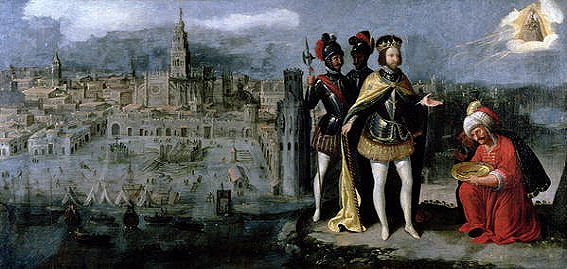
In the 13th century, Muslim rule on the Iberian Peninsula began to decline. Castilian King Ferdinand III “saved” Seville and drove Arabs and Jews out of the city. In the typical medieval Church spirit, Islamic buildings began to be intensively transformed into Christian ones, and the aristocracy “commandeered” the delicious palaces of their predecessors. Unfortunately, Seville fell into economic ruin, from which it was only lifted up by the era of great geographical discoveries. Before this happened, however, the metropolis was “in-famous” as the first tribunal of the Spanish Inquisition and the site of a particularly brutal massacre of the Jews.
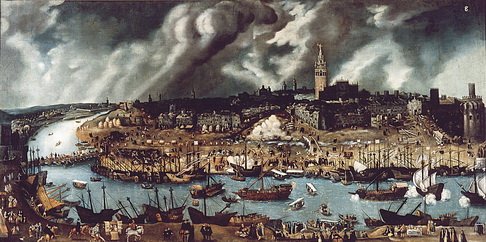
The discovery of the Americas under the Spanish flag marked the beginning of prosperity in which Seville was to be a major participant. In 1503 Casa de Contratación, an institution dealing with the regulation of trade relations with the New World was established. For the next two hundred years, the local mint transformed the gold and silver brought from across the Atlantic into coins, and the port flourished not only thanks to the transport of goods but also as a base for brave emigrants. The cathedral was restored in exquisite Gothic-Baroque style, and sumptuous public buildings appeared in the center. One of them was a hospital, which today is the seat of the Andalusian parliament (close to the Macarena Basilica). No wonder that in the 16th century, Seville was one of the richest and most populous cities in Europe – with a population of 150,000!
Unfortunately, exploiting overseas colonies, without equipping them with local industry or trade, proved to be a short-sighted tactic. In the 17th century, the economic boom ended quite abruptly. However, it did not prevent the intensive development of culture and art. Diego Velázquez himself began his painting career in Seville, and the painter Francisco de Zurbarán, the sculptor Juan Martínez Montañés and the neoclassical poet Fernando de Herrera also joined the group of the greatest artists of the Spanish Baroque. It is even said that Miguel de Cervantes invented the basis of his famous novel “Don Quixote” while spending time in a prison in Seville!
The city was not spared by the Black Death, which reduced the number of inhabitants by half. To make matters worse, the progressive silting of the Guadalquivir River meant that ships stopped entering Seville. What made matters even worse, all of Spain plunged into fights with the Habsburgs, which drastically burdened the royal budget. The only positive event of this period was the opening of the Royal Tobacco Factory in Seville, which became the beginning of a better, industrial future.
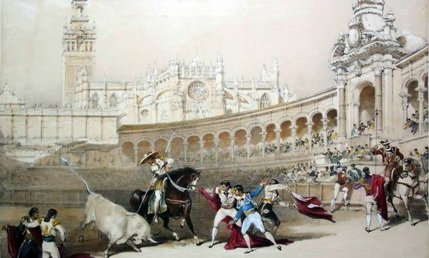
At the turn of the 18th and 19th centuries, the city finally rose from its knees. The wise Bourbon (starting with Philipe V) government and the accompanying development of the rail network played a significant role in this renewal. The Enlightenment period brought new manufacturers to the city – tobacco, salt, and weapons. It was also the moment of the highest popularity of the bullfights, thanks to the Maestrantes de Caballeria.
Unfortunately, the devastating yellow fever epidemic was followed by a wave of political anxiety over Napoleon’s expansion in Europe. There was a revolutionary change of power in the city, but in the face of the overwhelming majority of forces, Seville surrendered to the French in 1812.
After the defeat of Bonaparte, the Spanish crown established the administrative province of Seville, and the reign of Queen Isabella II was another positive influence on the city. Extensive investments included the construction of the Puente de Triana bridge, installation of street lighting, street renovation, and development of ceramics and porcelain production.
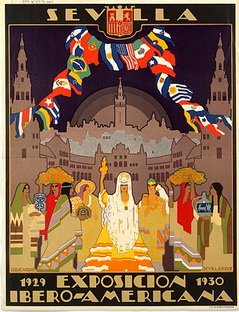
In 1929, Seville once again became famous around the world as the site of the Iberian-American Exhibition, which entailed further architectural modernization. Strong nationalist rule saved the city from the devastation of the Spanish Civil War, and later World War II.
Exactly 500 years after the discovery of America, Seville hosted the symbolic World Expo attended by over a hundred countries from all over the world.
In 2011, the city was decorated with the monumental Las Setas – the largest wooden structure in the world. It is hard to better crown the extraordinary history of the legendary Hispalis!
Sources and links:
- have a look at the Moorish past with ABCdesevilla – remember to unblock the ads or the page may not work
- great webpage full of photos, created by the passionate Spanish people – check out Verpueblos
- history told with pictures – video